
From Wikipedia : A coal breaker is a coal processing plant which breaks coal into various useful sizes. Coal breakers also remove impurities from the coal (typically slate) and deposit them into a culm dump. Coal tipples typically were used at bituminous coal mines, where removing impurities was important but sorting by size was only a secondary, minor concern. Coal breakers were always used (with or without a tipple) at anthracite mines. While tipples were used around the world, coal breakers were used primarily in the United States in the state of Pennsylvania (where, between 1800 and the mid-20th century, many of the world’s known anthracite reserves were located).
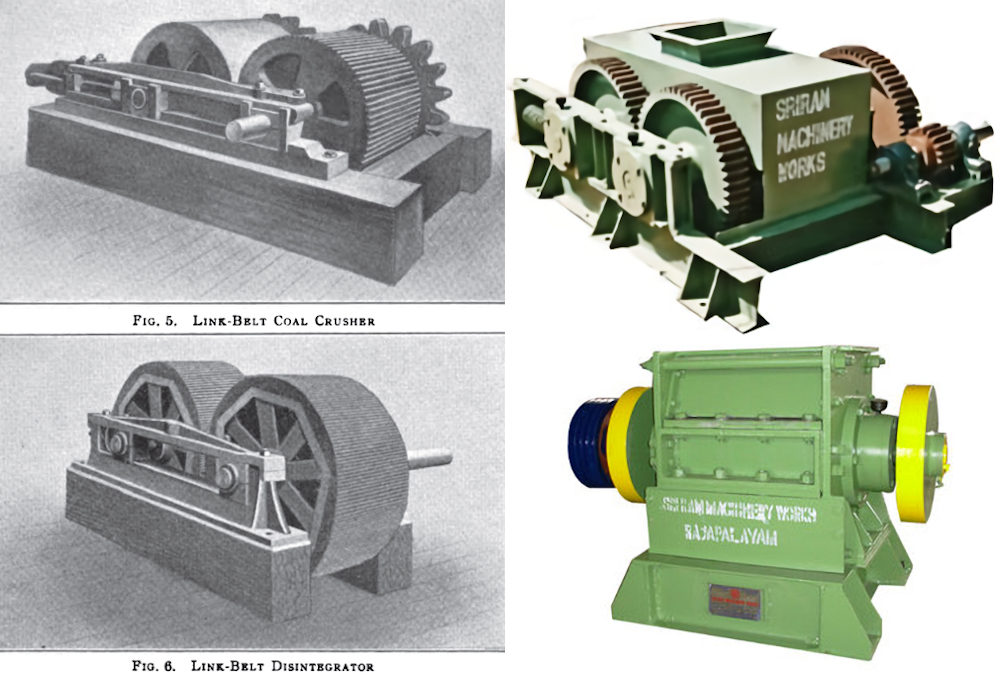
I had plans for a coal washery which included a coal breaker. I’m not a “rivet counter” when I mode … it doesn’t bother me at all to free-lance something. I am more of a “rivet spacer” … meaning I am happy when a model has the appearance of something that “could have been” .. that rivets used are the correct size and spaced right .. that visually it looks right.
I used the coal breakers shown to the left to create my own design. The one at the top right especially influenced my design .. with a heavy influence of late 19th and early 20th century designs.
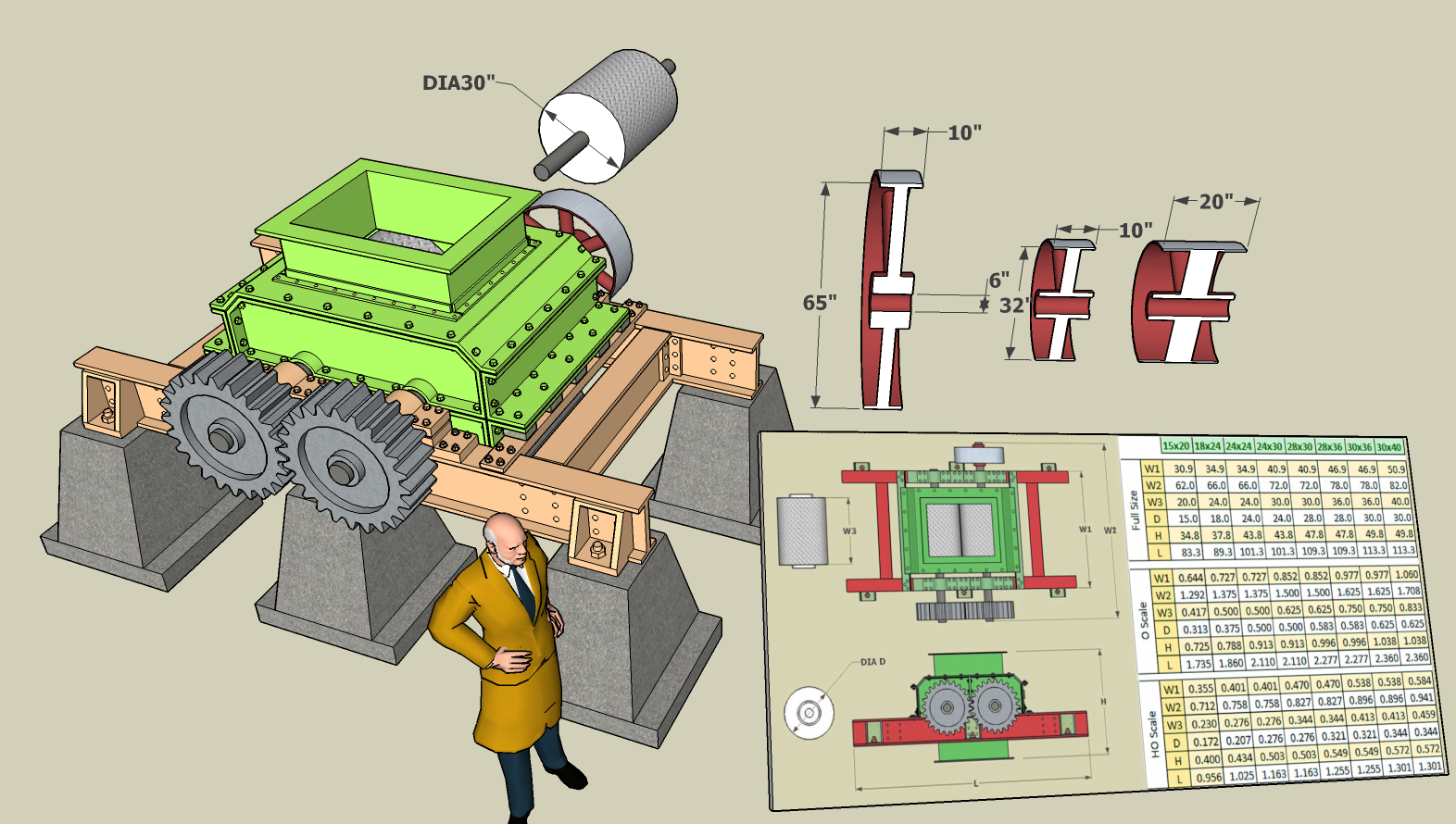
My design. Like I said before, based a lot on the top right one above. In the image to the left and up you see one of the rollers which is 30″ dia. If you look at the chart that’s the far right column. There are three different pullies shown. What size needed depends on the speed of the steam engine and the required speed of the breaker to operate efficiently. The width of the belt/flat pulley depends on how much HP is transmitted, how the belt is designed and so on.
I personally like the larger 65″ dia pulley simply because of the “cool effect”. The shafting which shows as 6″ (this being O scale) is 1/8″ rod – in reality could be any scale .. just the dia. of the roller etc. would change. Example in HO it would be a 54″x76″ roller ..
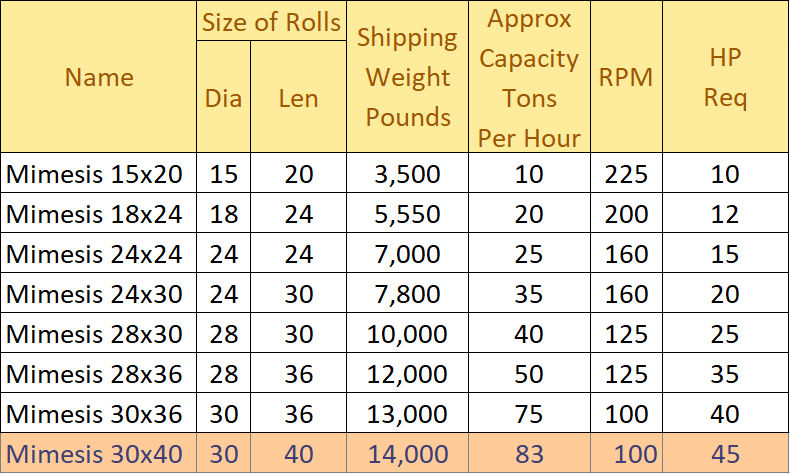
I found this chart on Google Books from an early 20th century book. It only went up to 30″ x 36″ rollers but that it 13,000 lbs. .. a pair? Not a problem for model railroaders but note the 40 hp requirement. I copied the chart into a spreadsheet to calculate for 30″x40″ rollers – honestly a mostly guess. That HO breaker with 54×76 rollers (meaning using this O scale model for HO) would need an engine over 280 HP. Simply scaling from O to HO .. 87.1/48=1.815 .. then 83×1.815=~150 tons per hour .. a bit much .. IMO.
Fun to play with the numbers. Early steel ore cars 1910s-1930s) say 50 tons or 3 cars per hour. I think sometimes figuring what capacity the facility on your layout allows you to work back for appropriate sizing .. or I simply need more coffee this morning.