
Let’s gather some info …
- for the 1860s: “The earliest iron hull plates were very small by today’s standards, no more than 6 ft by 2 ft 6 in. by approximately 3/4 to 7/8 in. thick, and with about 18 in. frame spacing.” 1
Frame Spacing: The 18″ frame spacing is from the 1860’s .. the Grazyna is the 1880’s so .. ummm .. 20 years on. Gives me a general starting point for the riveting. Elsewhere I saw that modern warships can have the frame spacing at 1 meter intervals. So for the Grazyna I am going to go with 2 ft. That is 1/2 in in O scale.
Plate Size: Small by today’s standards .. 30″ x 6′ maximum. - Ship hull plating was fabricated with Pan Head rivets. These had a large cylindrical head with a trapezoidal cross section on one end. 2
- Shell plating: The bottom and side shell plating consists of a series of flat and curved steel plates generally of greater length than breadth butt welded together. The vertical welded joints are referred to as ‘butts’ and the horizontal welded joints as ‘seams’ . Stiffening members both longitudinal and transverse are generally welded to the shell by continuous fillet welds. Framing is notched in way of welded plate butts and seams. 3
Note: This refers to welded plate but the shape of the plates should be the same for riveted plating.
Note: Flat cars in the 1880s were primarily constructed of wood and were significantly shorter than modern counterparts, generally measuring between 28 and 36 feet in length. Commonly used narrow-gauge flat cars, such as those used on the Carson & Colorado Railroad, were often 30 feet long. 4
Note: I am going to therefore say that the maximum length of plate used will be 30 ft and width of 6 ft (7-8.5 ft). In O scale that is 7.5 in x 2 in. 5
- Model Ship World – “What is the exact thickness of plates of iron in the 1870s?”
- Ships of Scale – iron-steel-plates-and-rivets
- Science Direct – Stern Frame –
- AI Overview – Model Railroader and Carson and Colorado Freight Car Roster 1880-1900 – maximum plate length that can be shipped
- Trainorders.com – width of flatcar .. how wide a plate can be shipped.
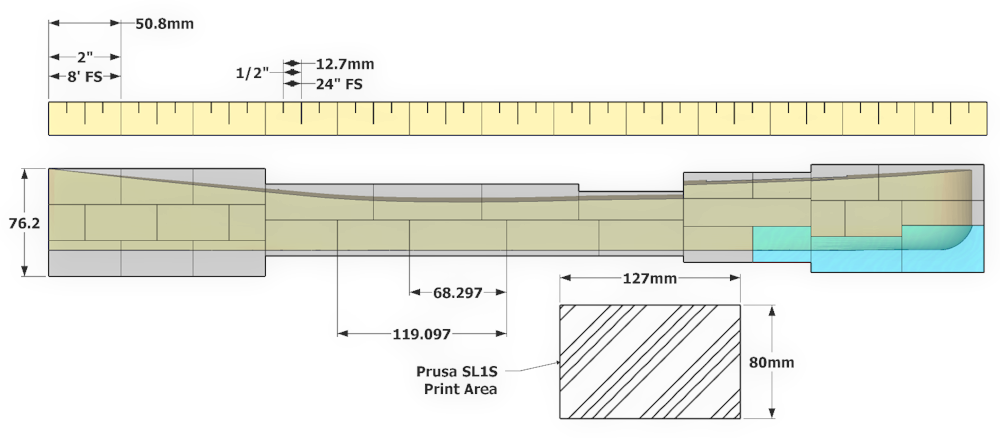
Plotting stuff: Based on the above I made the rule at the top of this diagram with 1/2″ tick marks representing the 2 ft frame spacing in 1:48. The plate sizes vary .. from a scale 8′ to 10′ in length and generally about a scale 4′ wide. Butts are staggered .. mostly. This is a starting point. Note the two plates measuring 119.097mm. This would fit on the print plate but close to the edges. The idea is to 3d print the plating with alternate bands proud of the one above and below complete with rivets. I want the print to stagger the plates while keeping the plate lengths so the print fits on the build plate.